Monday, 9 March 2015

Subtextual Documentalists

Subtextual Documentalists
Jyoti Bhatt & Manisha Gera Baswani
Presented 7th Nov to 20th Nov 2014
A SITE art space &
The Collective Studio Baroda
Collaboration


The process of archiving is the preservation of things considered to be of significance. The need to keep anecdotal memories alive for posterity, so that they remain palpable and assertive long after their occurrence, allows for personal histories to contribute to larger episodes of historical narratives. Such undertakings hold socio-cultural value as they call attention to subjects that lie outside of prescriptive academic interests, and which would otherwise be lost or forgotten without this insistence to memorialising them through independent endeavours of historicity.

Jyoti Bhatt and Manisha Gera Baswani are self-designated documentalists. The camera became an interjectory tool quite by accident for both these artists. However, they very quickly adapted to observing life through a camera lens, and began to use it in diaristic ways. Their common interest in documenting their respective contemporary surroundings by photographing them persistently and exhaustively, offers us revelations that would otherwise be obscured and off limits from any recorded scrutiny.

These photographs record events and occurrences of the life and times of an art community, and by virtue of their proximity to the professions of their subjects, Jyoti Bhatt and Manisha Gera Baswani become participants unwittingly within this chronicled history; lending these images a subtext of autobiographic interpretation.  Being privy to these private worlds disallows them from ever becoming voyeurs. Instead you recognise the ambient connection they forge with these photographic narratives that also reflect the prevailing cultural climate they both belong to.

Jyoti Bhatt’s black and white photographs presented in this exhibition evoke an era where the climate of cultural change within India was charged with passionate discourse, and where the implementation of newly formed governing modules for national platforms of art activities were being strategized. Art education and independent art practices began to flourish in post-colonial India. Stalwarts like N.S.Bendre, Shankho Chowdhury and K.G Subramanyan, along with cultural theorists, re-phrased aesthetic canons that were instrumental in shaping those early years of Indian contemporary art. Many of the people photographed in these images were engaged in articulating ideas of modernity, and its newly phrased implications. Jyoti Bhatt places these moments of personal struggle and collective enquiry before us, without any desire to underline its historical importance, but instead offers it as a personal journey he has been part of. In his usual self-effacing way, he underplays his role as a visual orator who immortalised an era of seminal change within Indian contemporary art.  What we receive therefore is the gift of a genealogy through this documentation, to which we can trace our own belonging.

Manisha Gera Baswani’s coloured photographs on the other hand, take you into a more assured stance of contemporary Indian art history, where the artist and their practice has acquired a more autonomous space of existence. In this time zone the discourse of Indian art has shifted to encompass the global as a context of belonging. The lens holds focus on her subjects, often in isolation, making them occupy centre stage, thereby emphasizing the role of the artist as an individual - confident and firmly entrenched within a social space of urban acceptance. Her photo documentation is culled from the terrain of an establishment that already holds its rightful place within today’s contemporary cultural history. As a viewer you are led into each photo image to confer with a space of private thought, where you recognise the prevailing intimacy of the moment as fleeting, and therefore supremely special. Manisha Gera Baswani holds you captive to the celebration of artistic musings. She draws your attention to the details that illuminate the character of her subjects and their relationship with their work. Whether in a gallery space, in their studios or homes, or in quiet solitude of reverie, the world of the artist becomes the sequestered prism through which all else is viewed. Contemporaneity recorded will now lend itself to posterity. 

Rekha Rodwittiya - 2014


Sunday, 8 February 2015

Residual Remnants


Residual Remnants
a group show
presented from 10th to 18th October 2014
as a SITE art space & The Collective Studio Baroda collaboration
in Vadodara


Residual Remnants  was the first exhibition of a the one-year collaborative venture between SITE art space & The Collective Studio Baroda, which opened on the 10th of October 2014 and concluded on the 18th of the same month. Sharing a vision for art that focuses upon community and interaction as seminal features that we wished to engage with, our desire was to also highlight alternative spaces of exhibiting and discourse as valuable and critical to sustaining an energized and ever-evolving art context for the city of Baroda.

The curatorial premise for this show was based upon viewing the perceptions of five artists in relation to how they negotiate specific observations of an outer world, and how these works then configured a discourse within this presentation. Each of these artists’ possess personal pictorial languages that are borne from information and experience, which then phrase the conceptual territories that they examine, with the particular pertinence that underlies their personal politics and addresses concerns of humanism that is central to all five. These filtered perceptions are processed to create a space of distance for themselves, thereby transposing the work to hold wider meaning, and to allow collective concerns and empathy to be recognized and shared.

Abir Karmakar concerns himself with a corporality of flesh and body that examines matter and substance through the erotic of transmuted experiences. Every space contains an imprint that validates the human presence being recognized. His sensual feel for paint is almost devotional, as he beckons you to enter into a place that feels familiar - sometimes dislocated and at other moments a place of intimate belonging. He is the quintessential easel painter, whose work reflects the history of art without burden, holding relevant the practice of his painting as one would the obsession with a lover denied. His world, like a labyrinth, keeps you in its maze, entranced.

Kim Kyoungae takes you into a sensual space of pulsating life that is steeped in the blood red of purgation. Derived from the experiences of caring for her mother during her battle with cancer, these works are like votive offerings that hold the evocations of life-giving prayers, at an altar of mortality.  Pristine, these burgeoning forms are like ritual flowers of regenerative power. Tactile, you feel their magic powers in the sacrificial red that seeps through these forms - ever pervasive and real.

Mitali Shah pieces together layers of material that mesh a surface that conjectures the pain and fatality of a city- disintegrating and revamped, each day. Like a perpetuating cyclic of inevitability, this life and death ritual plays out. These wounds, punctured and torn open, are poetic verses of quiet anguish; delicate yet incisive truths of disregard and neglectfulness.

Poushali Das borrows from the narrative traditions of manuscript and miniature painting to re-engage with a world of nature that she believes has become a dispossessed space within the cacophony of mega-media techno-indulgent ideas of existence. She believes in a universe of co-existence where a heightened consciousness perhaps offers a journey of discovery to a more ordered and mediated world; thereby placing all energies within the harmonies of an ideal existence. She demands of you to enter into the story-telling and to find your echo within it. Feminine territories are not accidental playgrounds nor fetish spaces of self-indulgence in her work. Poushali presides over her poetic visual missives with a precise understanding of her own empowered space as woman; sensuous, awakened and free.

T.Venkanna carries the beguiling camouflage of being child-man, both within his persona and his work. This tight-rope walk is a balancing act which plays out his explorations of the world of sexuality-part pleasure, part service, sometimes notional and at other times real and subversive – but always omnipresent. He recalls a childhood where sexual information held proximity to his space of innocence, leading him to examine the world from this prism of eroticism. In the seemingly explicit imagery you however chance upon clues to decipher from, which holds a subtext that the artist encrypts. Like a maverick, Venkanna defies the norms of expectancy and delivers his magical world that questions and confronts the stereotypical ways in which sexuality is understood and defined, without apology.

Rekha Rodwittiya-2014


Saturday, 7 February 2015

A collaborative endeavour - SITE art space & The Collective Studio Baroda

From left to right- Piyush Maheshwari, myself, Manish Maheshwari & Surendran Nair
at SITE art space Baroda

In June 2014 I conceived of a collaboration with Manish and Piyush Maheshwari, two brothers who run Rachaita Creative Solutions, to curate present five exhibitions to the city of Baroda.

SITE art space and The Collective Studio Baroda both share a vision for art that focuses upon community and interaction as seminal features that we wished to engage with, as well as to also highlight alternative spaces of exhibiting and discourse as valuable and critical to sustaining an energised and ever evolving art context. Our desire was for the programs to generate excitement and participation which would allow for this idea of cultural engagement to be a rewarding experience for the city of Baroda.

SITE art space is situated at GIDC Makarpura within the heart of the industrial production zone. The exhibition space designed by Mumbai based architect Samira Rathod is beautiful, and lends itself to interventional transformations. Having the gallery space along side the fabricating unit, a display space of art products designed and executed by artists, a library, a residency program unit and a pop up cafĂ© space, all within a primarily industrial location reaffirms the emphasis of reinstating alternative art spaces as a continued tradition that is a valued part of art history. The underlying thrust was for the community of artists and the audience to be more intimately engaged with discourse and interaction.


The Collective Studio Baroda was set up in the traditions of the guru shishya practice where students and young artists live and work together with Surendran and myself who host this initiative. It is a space of learning that does not charge any fee nor accepts any payback via works of art in exchange either. Founded on the principle of trust and belief to the commitment and passion to study art from the comprehension of it being a holistic world of imbibing knowledge and experience and where the rigours of long hours of studio practise are mandatory, the selection is through invitation only. Teaching, residencies, lecture programs, curatorial projects and fund raising are amongst some of the major activities that The Collective Studio focuses on. 

The rigour of this intensive curatorial and art management program has been personally exhilarating. Working pro bono and with a minimum budget that was self generated by the three of us, it has been extremely rewarding when  exhibitions  have  drawn in  audience numbers  touching 500 on an opening day. The artists and the citizens of Baroda have been very hugely participatory and for that , as a team, we feel great gratitude.


We began our season with a talk on conservation by architect Sanjeev Joshi.


In October  2014 we presented Residual Remnants


In November 2014 we presented Subtextual Documentalists


In December 2014 we presented This Side of the Forest 


In January 2015 we presented Measured Metres


Ankush Safaya was our artist in residence from 8th December 2014 to 10th January 2015


Today we present Six Generations: Notional Worlds


We present author Sanjay Kumar in conversation with Sadanand Menon on his new book Virgin Gingerly on the 21st of February 2015.

Watch this space for more visuals that will share each event in more detail regarding the work and displays.

So to all my readers who have been disappointed that I have been inactive on my blog, it has been this venture that has been the reason! 


Thursday, 5 February 2015

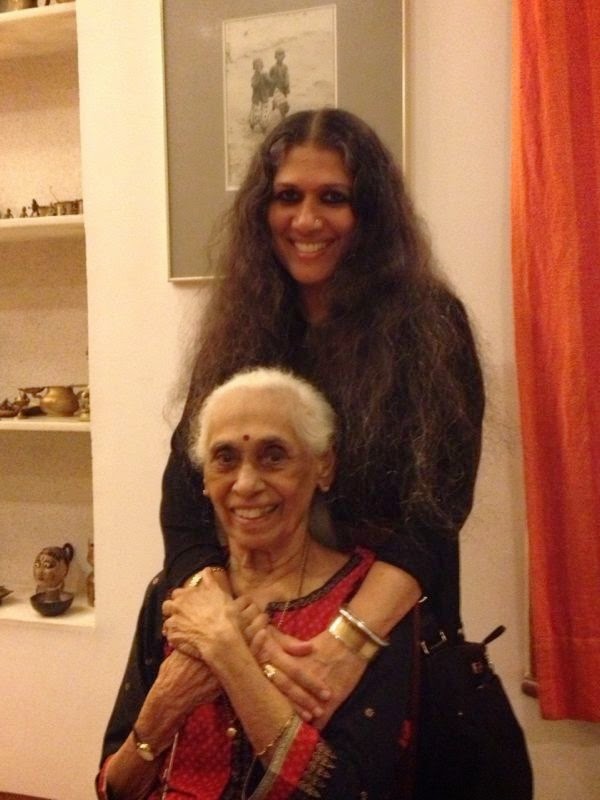
I miss you ma...

Amma passed away on the 21st of January 2015. You never know the day before that some calamity will push open your life and wind you emotionally; and that your life will change through that process in ways that are indescribable. 

Perhaps it was only after my mother was no longer with me that I understand how  integral  a part she was in my life.  Always central to every plan I made, she revelled in the fact that I would  attend to her every whim and desire. I was her problem solver, I was her confidant, I was her special girl. She always told with pride, the story of how she had insisted that she wanted another baby and so of course my father gave in, and I was conceived. She chose my name and loved me through all my growing years with a preciousness that I took for granted, which made it all the more sweeter to receive.

We were like chalk and cheese! I am the serious ponderous one, who the family laments as having no sense of humour,  with an eternally wagging finger of does and don't;  living most of my life swaddled in my apron. Amma on the other hand was this radiantly beautiful and elegant lady with impeccable  grace and taste, who could light up a room with her 100 watt smile and engage you with her wit and charm, like no other could.

I have this beautiful childhood memory of the rustle of her silk sari and the soft fragrance of her perfume as she would bend to kiss me good night. When facing legal complications at the time of my divorce, it was my mother who squarely admonished me when I felt defeated by it all. She reminded me that my freedom and liberty was an empowerment that I should never squander and that my independence was a sacred space of existence, to be valued and protected at all times. Fiercely independent herself almost to a fault,  she lived her life with discipline and dignity, keeping her two daughters at the centre of her heart and life always.

As all mothers and daughters, we too fought. But these fights were always over silly issues of whether Amma was wearing her sweaters or not, or whether she was being fussy about her food, or had she skipped her exercise regime to read the newspaper instead. For all the big things that really mattered, she was my biggest fan and supporter. For her I was the best daughter anyone could have. Of course I  held that crown tightly and with great pride, and loved the fact that I was the person in her life who could protect and fuss over her like no one else. I cannot attempt to describe my sense of lose. It is carried deep inside me, hidden away from all, like a secret not to be revealed. However the wisdom of my mother would have hated a moping daughter, and the funny bone in her would have tickled out a laugh at all costs. 

She taught me how to live unhindered by doubts or regret…..
She was the best mother any daughter could have ever dreamt of having.
Her imprint in my life will never fade.
I hold with pride her love and delight of being my mother.